
Spring 2026 Art Auction Tuesday 17th November 2026 at 6.00pm WST
More images
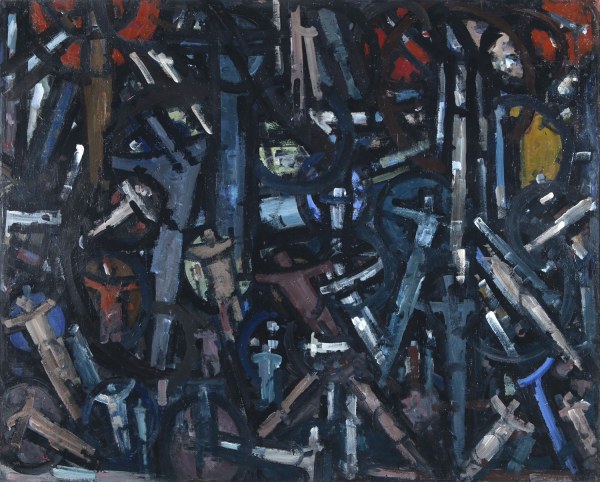
31. ROGER KEMP
(1908-1987)POETRY IN MOTION
Signed and titled verso
Acrylic on board
122 x 152.5cm
Estimate: $15,000/$22,000
Exhibited: "Paintings and Drawings in Retrospect" Mornington Peninsula Arts Centre, 1973 catalogue number 8.
Absentee/Telephone bidding closes in loading...
Choose your bid below. We’ll ask you to sign in before submission.
Absentee Bid
Enter the maximum amount you authorise the auctioneer to bid up to on your behalf. This amount does not include buyer’s premium of 18% plus GST (19.8% including GST).
Telephone Bid
Request a GFL Fine Art staff member to telephone you during the auction so you can bid live by phone.
Approximate scale
Framed approx. 143.5 x 173.5 x 5.0 cm

Visual guide only. Framed size is used when available; otherwise artwork size is shown.
About this artwork
Roger Kemp is a pivotal figure in Australian twentieth-century painting and, alongside Godfrey Miller, Ralph Balson and Ian Fairweather, occupies an important place in the development of Australian abstraction. Read full essay Show less
Roger Kemp is a pivotal figure in Australian twentieth-century painting and, alongside Godfrey Miller, Ralph Balson and Ian Fairweather, occupies an important place in the development of Australian abstraction.
Initially harbouring ambitions of a musical career, Kemp enrolled in evening classes at the National Gallery of Victoria Art School in 1929, aged twenty-one. He returned to study painting full-time in 1933, supported financially by his sister. Initially following the academic tradition taught at the school, his work began to move towards the flattened, angular forms of early Cubism during his final year in 1935, a departure that attracted criticism from his teachers. The arrival of the Ballets Russes in Melbourne in 1936 proved formative, encouraging Kemp to explore the relationship between art and music and to pursue themes of mysticism and human spirituality.
Kemp continued to work in the printing industry while developing his painting, eventually devoting himself to art full-time in 1966. His mature work increasingly employed geometric structures, ambiguous forms and luminous colour in a sustained search for a visual language capable of expressing spiritual and metaphysical experience.
This ambition was recognised in 1978, when Kemp's seventieth birthday was marked by Roger Kemp: Cycles and Directions 1935–1975, presented simultaneously across five Melbourne venues. Organised by Patrick McCaughey, then Director of the National Gallery of Victoria, the exhibition surveyed four decades of Kemp's practice. In the accompanying catalogue, McCaughey wrote: “Roger Kemp belongs to that group of artists who felt challenged by the modern world and resolved to find a pictorial form to meet the challenge.”
Kemp articulated this search himself in a 1973 interview with Robin Lockwood: “We are moving into a new space area. There is nothing there and you have to establish something. We have to re-level ourselves beyond the grid into a new area where we didn’t exist before…”
This untitled work embodies that pursuit. Its deep blues and reds possess the luminosity of a religious icon, while ambiguous forms—suggestive perhaps of human or avian figures—emerge within a structure of interlocking squares and rectangles. The tension between geometric order and organic form creates a composition that is both controlled and elusive. From a distance, its colour and overall structure dominate; at close range, the richness and texture of the surface become increasingly compelling.
Kemp's significance was reinforced by a succession of major awards, including the John McCaughey Memorial Prize in 1961, the Georges Invitation Art Prize and Transfield Art Prize in 1965, and the Blake Prize for Religious Art in 1968 and 1970. He was appointed OBE in 1978, an AO in 1987, and received an Honorary Doctorate from Monash University in 1984.
Kemp died at Sandringham in 1987, aged seventy-nine. His legacy remains that of an artist who transformed abstraction into a deeply personal language of colour, geometry, and spiritual inquiry.