
Spring 2026 Art Auction Tuesday 17th November 2026 at 6.00pm WST
More images
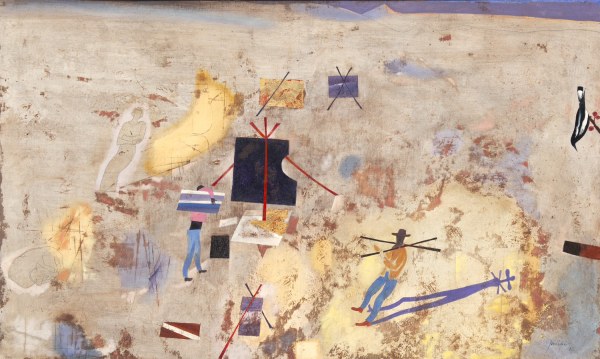
30. ROBERT JUNIPER
(1929-2012)MAKING A (TOTALLY) POINTLESS CONSTRUCTION IN THE DESERT
Signed and dated 83 lower right
Oil and acrylic on canvas
106.5 x 183cm
Estimate: $55,000/$65,000
Illustrated: "Robert Juniper" by Gavan Fry, page 102, published by The Beagle Press Sydney 2009.
Absentee/Telephone bidding closes in loading...
Choose your bid below. We’ll ask you to sign in before submission.
Absentee Bid
Enter the maximum amount you authorise the auctioneer to bid up to on your behalf. This amount does not include buyer’s premium of 18% plus GST (19.8% including GST).
Telephone Bid
Request a GFL Fine Art staff member to telephone you during the auction so you can bid live by phone.
Approximate scale
Framed approx. 107.5 x 184.0 x 2.5 cm

Visual guide only. Framed size is used when available; otherwise artwork size is shown.
About this artwork
Some of the qualities that set Robert Juniper’s art apart from that of his contemporaries were the confidence with which he handled his medium and his highly developed sense of design. Shapes within the composition were strategically placed for maximum effect, each leading the eye towards another until the balance and visual structure he sought was achieved. Read full essay Show less
Some of the qualities that set Robert Juniper’s art apart from that of his contemporaries were the confidence with which he handled his medium and his highly developed sense of design. Shapes within the composition were strategically placed for maximum effect, each leading the eye towards another until the balance and visual structure he sought was achieved.
He was greatly aided by his experience of flight in his depiction of the Australian landscape. From thousands of metres above the earth, and from the security of an aircraft, Juniper discovered an underlying order within what might at ground level appear to be chaos. From around 1980 onwards, he devoted himself increasingly to this aerial approach, developing a distinctive way of viewing and interpreting the landscape that became one of the defining characteristics of his work.
Juniper also possessed a characteristic understanding of when a work was complete. He rarely overworked a painting, allowing areas of the composition to retain their freshness and creating a convincing sense of space. Rather than directing the viewer towards a single dominant focal point, he encouraged the eye to travel across the entire picture plane, discovering relationships between the various forms and details.
Although Juniper approached the landscape with considerable purpose, he was also capable of introducing an element of humour into both his compositions and their titles. His humour, however, should not be mistaken for a lack of seriousness in the work itself. It was often a means of introducing a narrative into an otherwise carefully constructed composition.
In this work, the primary figure Juniper, carries wooden planks on his shoulders, their arrangement and the resulting shadow create a windmill-like form, a structure often seen in the desert. The title, Making a (Totally) Pointless Construction in the Desert, reflects Juniper’s characteristic wit, suggesting that the considerable effort being expended may have little practical purpose beyond contributing to the visual drama of the scene. His Rhodesian Ridgeback appears entirely indifferent to the activity, continuing to sleep, while the female figure, with folded arms and a stance reminiscent of a classical Greek pose, appears equally unwilling to participate in the enterprise. Her clothing, which is ill-suited to the harsh desert environment, further heightens the gently absurd quality of the scene.
These touches of humour are characteristic of Juniper and provide an engaging counterpoint to the work’s formal sophistication. Beneath the wit, however, is a carefully resolved composition in which figure, landscape, shadow, space and form are brought into a deliberate and harmonious relationship.