
Spring 2026 Art Auction Tuesday 17th November 2026 at 6.00pm WST
More images
21. EDWIN SUMMERHAYES
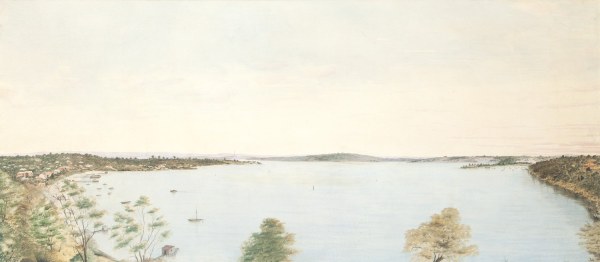
(1864-1944)FRESHWATER BAY
Initialled and dated (19)18 lower left
Watercolour
41.5 x 90cm
Estimate: $9,000/$12,000
Absentee/Telephone bidding closes in loading...
Choose your bid below. We’ll ask you to sign in before submission.
Absentee Bid
Enter the maximum amount you authorise the auctioneer to bid up to on your behalf. This amount does not include buyer’s premium of 18% plus GST (19.8% including GST).
Telephone Bid
Request a GFL Fine Art staff member to telephone you during the auction so you can bid live by phone.
Approximate scale
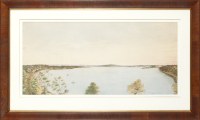
Framed approx. 69.0 x 115.0 x 3.5 cm

Visual guide only. Framed size is used when available; otherwise artwork size is shown.
About this artwork
Edwin Summerhayes was born in Greenwich, London, in 1868. In 1884, when he was sixteen, he came to Australia with his family. His architectural training took him first to Adelaide, where he was articled to James Hill, and then to Melbourne, where he continued his studies under William Pitt, one of Victoria's leading architects and the designer of such prominent buildings as Melbourne's Princess Theatre. Summerhayes was also a keen cyclist and twice competed prominently in the Austral Wheel Race at the Melbourne Cricket Ground. Read full essay Show less
Edwin Summerhayes was born in Greenwich, London, in 1868. In 1884, when he was sixteen, he came to Australia with his family. His architectural training took him first to Adelaide, where he was articled to James Hill, and then to Melbourne, where he continued his studies under William Pitt, one of Victoria's leading architects and the designer of such prominent buildings as Melbourne's Princess Theatre. Summerhayes was also a keen cyclist and twice competed prominently in the Austral Wheel Race at the Melbourne Cricket Ground.
In 1894, Summerhayes moved west at a time when opportunity in Melbourne was in short supply. The city was in the grip of a severe economic depression, and architects and builders were among those feeling the effects as building activity contracted. Western Australia, by contrast, was being transformed by the discovery of gold, and the rapidly expanding goldfields offered opportunities that were increasingly difficult to find in Melbourne.
He established his architectural practice in Coolgardie, where the extraordinary growth of the goldfields created a demand for almost every kind of building. Among his work there were the Turkish Baths, Jewish Synagogue, Presbyterian Church, Mechanics Institute and Exhibition Building. It was an exceptional beginning for a young architect in a town that was itself being created almost overnight.
By the mid-1890s, Summerhayes was dividing his time between the goldfields and Perth. In 1896 he married Florence May Camm and established his family home in Bernard Street, Claremont, in a house he had designed and built himself. Their son Reginald was born there in 1897, beginning a family connection with Western Australian architecture that would continue for three generations.
In 1896 Edwin Summerhayes was among the founding members of the West Australian Institute of Architects. His career in Perth developed rapidly. He designed the Claremont Municipal Chambers and later served as a member of the Claremont Council. His work extended well beyond Claremont, with buildings and residences appearing across Perth and regional Western Australia.
During the First World War, Summerhayes served as a major with the 44th Bataillon and was sent to the Western Front in 1916. Here the architect's eye seems to have followed him. Amid the destruction of France and Belgium, he continued to draw and paint. The Australian War Memorial holds a number of his watercolours, including scenes at Étaples, Houplines and Le Touquet. They are not simply picturesque records: they were made while he was serving with the 44th Battalion and, in the case of Houplines during one of the most significant battles in which his unit took part.
After returning from the war, Summerhayes continued to work as an architect in Perth. Yet it is perhaps his paintings that provide the most intimate glimpse of the man behind the professional career. This 1918 work Freshwater Bay is a record of the development of the Swan River foreshore, but it can also be read in the shadow of his recent experience of France. Having witnessed landscapes transformed and devastated by war, Summerhayes returned to a Perth that was itself changing, though in a very different way. The quiet foreshore in Freshwater Bay is therefore more than a pleasant view of early Perth. It captures a landscape in transition and, perhaps, the particular sensitivity of a man who had seen what could be lost when landscapes were destroyed. The painting becomes a fragment of a city in the process of becoming the metropolis of today, recorded by a man who had spent much of his life helping to shape it and who had only recently returned from a landscape profoundly altered by war.