
Spring 2026 Art Auction Tuesday 17th November 2026 at 6.00pm WST
More images
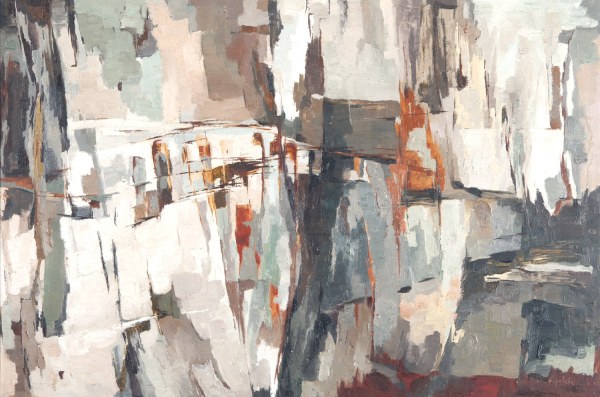
97. JEAN APPLETON
(1911-2003)ABSTRACT
Signed lower right
Oil on board
50 x 75cm
Estimate: $5,000/$8,000
Absentee/Telephone bidding closes in loading...
Choose your bid below. We’ll ask you to sign in before submission.
Absentee Bid
Enter the maximum amount you authorise the auctioneer to bid up to on your behalf. This amount does not include buyer’s premium of 18% plus GST (19.8% including GST).
Telephone Bid
Request a GFL Fine Art staff member to telephone you during the auction so you can bid live by phone.
Approximate scale
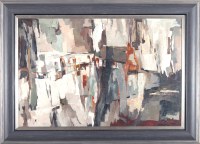
Framed approx. 66.0 x 92.0 x 4.5 cm

Visual guide only. Framed size is used when available; otherwise artwork size is shown.
About this artwork
If you were an impoverished artist from overseas living in a garret waiting for work and fame, baked beans might just become your staple diet. Jean Appleton recalled this during an interview with The Sydney Morning Herald in 1939. She had just returned from London after three years abroad and considered herself something of a baked-bean expert, as several times during her studies she had been “on the baked beans line”, along with many of her colleagues. “They are nice, and sixpence buys you so much,” she would say. Read full essay Show less
If you were an impoverished artist from overseas living in a garret waiting for work and fame, baked beans might just become your staple diet. Jean Appleton recalled this during an interview with The Sydney Morning Herald in 1939. She had just returned from London after three years abroad and considered herself something of a baked-bean expert, as several times during her studies she had been “on the baked beans line”, along with many of her colleagues. “They are nice, and sixpence buys you so much,” she would say.
The Glasgow Wool Exhibition of 1938 was a lifeline for Appleton and many of Australia’s budding artists who were furthering their education in England. The International Wool Secretariat had commissioned a 170-foot-long (55-metre) tapestry to be displayed in its pavilion, depicting the development of wool throughout history.
Arthur Murch was in charge of the project and engaged young Australian artists studying in London to assist him. Donald Friend, William Dobell, George Duncan and John Santry were among those employed by Murch, with Jean Appleton and Barbara Tribe being the only women in the crew. And, as might be expected from such a talented group, there was plenty of work and plenty of fun during the commission.
Prior to travelling to London, Appleton had studied and graduated from East Sydney Technical College. In 1935, with the benefit of a small allowance from her father’s estate, she travelled by cargo ship to England to study at the Westminster School, where her principal tutors were Bernard Meninsky and Mark Gertler.
The outbreak of the Second World War forced her return to Australia before she was ready, and she longed to return to Europe. She eventually did so in 1951, where she reunited with her artist friend Tom Green, whom she married in Sydney in 1952. Three years earlier, in 1949, her first husband, the artist Eric Wilson, had died of pancreatic cancer. Appleton described their marriage as not unhappy but difficult. Wilson was a strong personality with forthright views about art.
Jean Appleton’s nature was gentle and elegant, and she was totally absorbed by the art world, making, exhibiting and teaching throughout her life. Her work is represented in most state galleries across Australia, and she held 21 solo exhibitions and participated in numerous group exhibitions.
In June 1996, she held a joint survey exhibition with her friend and colleague Norah Heysen at the Southern Highlands Regional Gallery.ML
Jean Appleton: A Lifetime with Art, by Christine France, was published in 1998 by Caroline Simpson.