
Autumn 2025 Art Auction
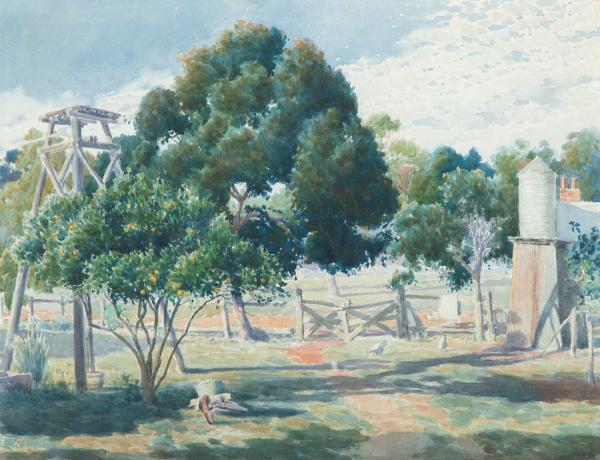
53. JAMES WALTER ROBERT LINTON
(1869-1947)FARMYARD PICKERING BROOK
Signed with monogram lower left
Watercolour
40 x 54cm
Estimate: $5,000/$8,000
Hammer Price - $7,500
Exhibited: "The Linton Legacy" Art Gallery of Western Australia, Centenary Gallery, February to November 2003.

Visual guide only. Framed size is used when available; otherwise artwork size is shown.
About this artwork
Linton is a key figure in the development of art in Western Australia, particularly during the turn of the 20th century. This work “Farmyard Pickering Brook” stands as one of his most complete and significant watercolours, showing the core of his artistic abilities. Read full essay Show less
Linton is a key figure in the development of art in Western Australia, particularly during the turn of the 20th century. This work “Farmyard Pickering Brook” stands as one of his most complete and significant watercolours, showing the core of his artistic abilities.
To students of Western Australian art history, James W.R. Linton needs no introduction. He succeeded F.M. Williams as the head of the Perth Technical College School of Arts, and through his production of silver, furniture, and carving, was instrumental in shaping the Arts and Crafts movement in Perth at the turn of the 20thcentury. Linton's impact was unparalleled, and his enthusiasm for art was unmatched.
In an article published in the West Australian in December 1927, a correspondent writing under the name "Hermes" described Linton with admiration: "One’s first impression of Mr. James Linton is that he is wholly an artist. He loves art disinterestedly and for its own sake. He can talk about art all day long. All his spare moments are spent in his studio. And his appearance—the pointed beard, deep-set eyes, and flowing black bow tie—embodies the typical artist’s look. Partly because he is so full of art and has had such extensive experience, his conversation is always fascinating."
Born into a large family as one of eleven children, Linton’s famous father, Sir James Dromgole Linton, the President of the Royal Institute of Painters in Watercolour, made investments in gold mines in Western Australia. In 1897, young James was sent to Western Australia to oversee the family’s investments.
He arrived in Albany and went directly to Kalgoorlie where he lived rough in basic accommodation. He became ill and after recovering from a fever for which he was hospitalised, he left Kalgoorlie and arrived in Perth in 1899. Eager to build a career outside the shadow of his prominent father, Linton had previously attempted to make a living as a tea merchant, actor and book illustrator- all efforts were unsuccessful. In Australia, he was able to develop the independence he sought.
Linton purchased his Parkerville property in 1921, and the hills area soon became the primary source of subject for his artistic production. “Farmyard Pickering Brook” demonstrates his ability to capture the unique light of the region. Through this work, Linton skilfully balances the composition with the use of shadows, posts, clouds, and tree lines, guiding the viewer's eye across the entire scene. It is a masterful composition, rich in detail, yet devoid of any sense of arrogance.
Linton's work is included in the collections of the Victoria and Albert Museum, London, the National Gallery of Australia, the Art Gallery of Western Australia, and numerous private collections. Retrospective exhibitions of his work were held at the Art Gallery of Western Australia in 1955 and 1977.