
Autumn 2025 Art Auction
39. ROBERT JUNIPER
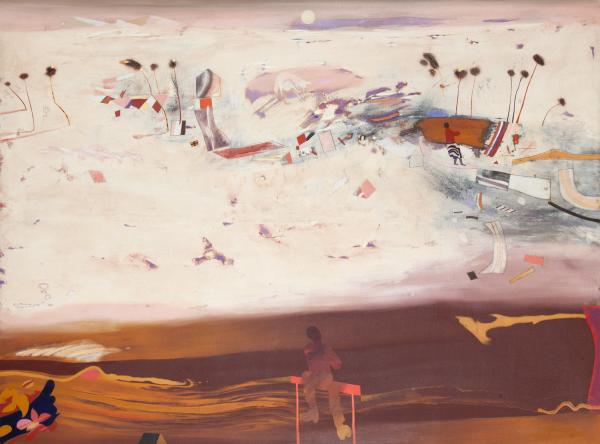
(1929-2012)THE RISING MOON ON GWALIA
Signed and dated 87 lower right
Oil, acrylic and graphite on canvas
182 x 243cm
Estimate: $70,000/$90,000
Hammer Price - $70,000
Illustrated: "Robert Juniper by Gavin Fry", Published by The Beagle Press 2009, Page 100.

Visual guide only. Framed size is used when available; otherwise artwork size is shown.
About this artwork
Writing about Robert Juniper can be challenging, as his contribution to Australian art history is often undervalued on a national scale, despite his significant influence. After the 1970s, Juniper’s approach to landscape painting underwent a transformation. Having experienced the landscape from the viewpoint of a light aircraft, he saw an underlying order that was not immediately apparent from ground level. This shift in perspective led him to change his approach to landscape painting by eliminating the horizon line and covering his canvases in earthy tones. He began to focus on the features of the landscape and the interplay of light across them, capturing the essence of the day's atmosphere without relying on the sky. Read full essay Show less
Writing about Robert Juniper can be challenging, as his contribution to Australian art history is often undervalued on a national scale, despite his significant influence. After the 1970s, Juniper’s approach to landscape painting underwent a transformation. Having experienced the landscape from the viewpoint of a light aircraft, he saw an underlying order that was not immediately apparent from ground level. This shift in perspective led him to change his approach to landscape painting by eliminating the horizon line and covering his canvases in earthy tones. He began to focus on the features of the landscape and the interplay of light across them, capturing the essence of the day's atmosphere without relying on the sky.
By skilfully varying his tone, Juniper was able to convey the changing moods of the landscape, whether it was a bright, clear day or a more subdued, cloudy one. Through his use of light and colour, he allowed viewers to experience the weather and atmosphere without relying on literal depictions. This technique provided a fresh perspective on the Australian landscape.
In “The Rising Moon on Gwalia”, Juniper subtly re-introduces the horizon, enabling the viewer to understand that the scene is illuminated by moonlight, rather than being a dull, overcast sky.
In a 1969 interview with Laurie Thomas, Juniper reflected on his sense of isolation, saying, “There have been periods when I felt I was out of the mainstream of Australian painting - because of the isolation of Western Australia. A few years back, it did worry me. But it doesn’t anymore.”Thomas, on the other hand, believed that Juniper had a poetic sensitivity to the Australian landscape. Yet, Juniper himself felt his focus was more localized, not concerned with the broader, national image of Australia. He explained, “I feel that I’m developing what I think is an indigenous thing - indigenous to Western Australia - because I don’t feel any strong influence from anywhere else.”
Juniper’s work is generally free from external influences, though his impact on other artists is widely acknowledged. If any artist is said to have influenced him, it was likely Sam Fullbrook. Upon first encountering Fullbrook’s North West paintings, Juniper remarked, “Fullbrook’s paintings then pulsated with the heat of the north and showed me for the first time a vision beyond the verdant rim, that hot gut of the Australian landscape.” While Juniper admired Fullbrook’s use of colour and would later adopt a similar palette, he never embraced Fullbrook’s glissando technique. Instead, Juniper was captivated by feel and the quality of paint, which he used to enhance the surface of his work.
By the time Juniper painted “The Rising Moon on Gwalia”, he had already gained recognition for his distinctive style and had become confident in working on a larger scale. He was also beginning to incorporate elements of both literal and artistic exaggeration into his landscapes. “The Rising Moon on Gwalia” evokes a powerful sense of memory, drawing from Juniper’s personal recollections of his visit to the region, while also inviting curiosity in those who have yet to experience Gwalia and its surroundings.
The painting captures a quiet, magical moment, immortalizing Juniper’s memory of the scene: a full moon rises above the ruins of a once-thriving town, casting subtle shadows across the land. The middle-distance glows with reflected moonlight, as the effects of the setting sun have faded. Juniper’s colour palette mirrors the tranquil atmosphere of this hour, while his gaze lingers on the unfolding scene of a kangaroo scratching and Juniper’s companion wandering through the ruins.“ The Rising Moon on Gwalia” stands as a major piece in Juniper’s oeuvre.