
Autumn 2025 Art Auction
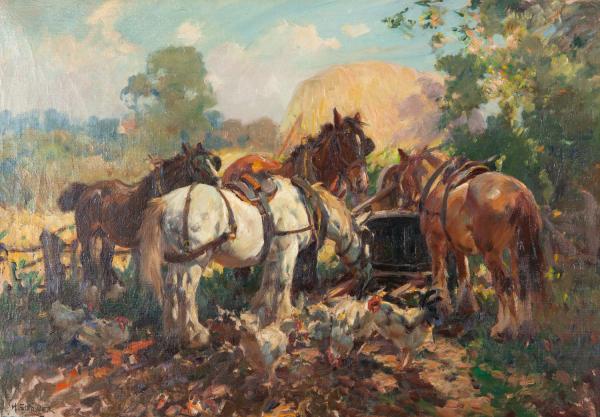
35. HAROLD SEPTIMUS POWER
(1878-1951)FEEDING TIME
Signed lower left
Oil on canvas
65 x 95cm
Estimate: $10,000/$15,000
Hammer Price - $18,000

Visual guide only. Framed size is used when available; otherwise artwork size is shown.
About this artwork
Though largely self-taught, Harold Septimus Power achieved admirable results in local art competitions during his youth. He won silver medals at the Collingwood Junior Exhibition in 1896 and 1899, and a gold medal at the Melbourne Art Club in 1899. Read full essay Show less
Though largely self-taught, Harold Septimus Power achieved admirable results in local art competitions during his youth. He won silver medals at the Collingwood Junior Exhibition in 1896 and 1899, and a gold medal at the Melbourne Art Club in 1899.
His first formal art education took place in Paris from 1905 to 1907, where he studied at the Académie Julian under Jean-Paul Laurens. Prior to this, he had received encouragement from the notable artist Walter Withers, as well as reluctant support from his father, Peter Power - a painting teacher in Brunswick - who was hesitant for his son to follow in his artistic footsteps.
Power was a versatile artist, skilled in portraiture, still life, and landscapes, but his true passion was for animals - horses in particular. Whether painting dogs, cats, camels, or birds, no creature from the animal kingdom proved too challenging for him. He was widely regarded as Australia’s premier painter of animals, possessing an innate ability to capture not only the physical likeness but also the spirit and individual character of his subjects - whether they were feeding, working, playing, or simply at rest.
He lived and worked in London for many years, earning numerous commissions for equestrian portraits and regularly exhibiting at the Royal Academy. Although a hearing impairment disqualified him from active service during World War I, he was appointed as an official Australian war artist and often worked under enemy fire. It was said that his hearing loss allowed him to concentrate amid the chaos of battle. The Australian War Memorial holds more than 60 of his works, most of them painted in France, with others completed after his return to Australia.
His work is included in all Australian state gallery collections, the National collection in Canberra and the Imperial War Museum in London.