
Autumn 2025 Art Auction
29. GEORGE PITT MORISON
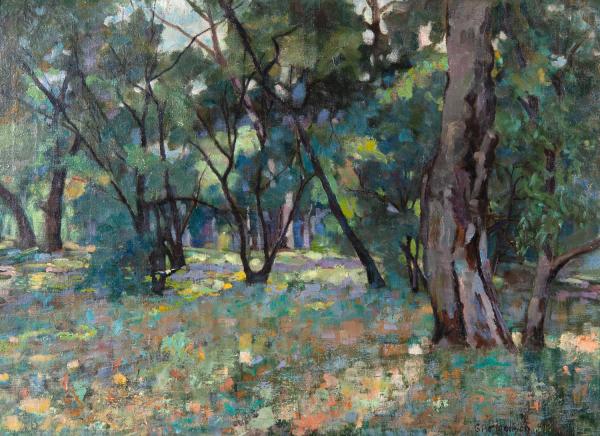
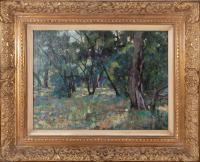
(1861-1946)THE SUNLIT BUSH
Signed lower right
Oil on canvas on board
44 x 59cm
Estimate: $5,000/$8,000
Hammer Price - $6,500
Illustrated: "Western Australia, Paint, Pencil, Camera 1931", Page 21.

Visual guide only. Framed size is used when available; otherwise artwork size is shown.
About this artwork
The highly regarded art critic for The West Australian newspaper, Charles Hamilton, wrote of Pitt Morison in 1939: “It is a pity this artist cannot devote more time to his studies, for one is always tantalized by the thought of what he could really do if he had the opportunity.” Read full essay Show less
The highly regarded art critic for The West Australian newspaper, Charles Hamilton, wrote of Pitt Morison in 1939: “It is a pity this artist cannot devote more time to his studies, for one is always tantalized by the thought of what he could really do if he had the opportunity.”
Born in Melbourne in 1861, Pitt Morison studied part-time at the National Gallery School and worked in various occupations until, in 1890, when he seized the opportunity to study in Paris at the Académie Julian, despite the objections of family and friends. While in France, he travelled around the countryside painting with fellow Australian artist Emanuel Phillips Fox, who was known for his paintings of dappled light. After his studies in Paris, Morison travelled to Spain, where he further refined his skills by copying the masterpieces at the Prado Museum.
In 1894, Morison arrived in Western Australia and worked in a photography studio in Bunbury before securing a position with the Land and Surveys Department. In 1906, he took on a role in the art department of the WA Museum and Art Gallery, where he remained in different roles until his retirement in 1942 at the age of 81.
Morison was a founding member of the WA Society of Artists and served as its president in 1906. He was also a member of The Perth Society of Artists and chaired the organization during the 1936-1937 term.
One of Morison’s most well-known works is “The Foundation of Perth” , commissioned by the Centenary Committee, of which he was a member. The painting, which depicts Mrs. Dance felling the first tree, was meticulously researched by Morison to ensure the accuracy of the clothing and the number of observers present at the event. The completed work was presented to the Art Gallery in 1929. Additionally, Morison designed the postage stamp issued to commemorate Western Australia’s Centenary.
Always impeccably dressed, Pitt Morison was a distinguished and influential figure in the Western Australia's arts scene. While he supported and applauded emerging art trends, his own work was more aligned with his classical training and a deep understanding of the old masters.
Despite his extensive study in Australia and France, Morison ultimately chose a career in arts administration over that of a practicing artist. He was a pragmatic individual with a family, and considered his responsibilities over personal ambitions. He exhibited annually with the societies of which he was a member, and early in his career, he even held exhibitions in his own home.
The painting “The Sunlit Bush” reflects Morison's classical training in composition, structure, and surface quality. The subject—a forest floor illuminated by sunlight—captures the contrast between the bright patches of sunlight and the more subdued shadows. The artist masterfully conveys the atmosphere of a cool, densely wooded scene, with the play of light acting as both a focal point and a guide for the eye.
Morison’s work is held in collections at the National Gallery in Canberra and the Art Gallery of Western Australia. Portraits of him were painted by his contemporaries Elise Blumann and John Brackenreg further cementing his legacy.