
Autumn 2025 Art Auction
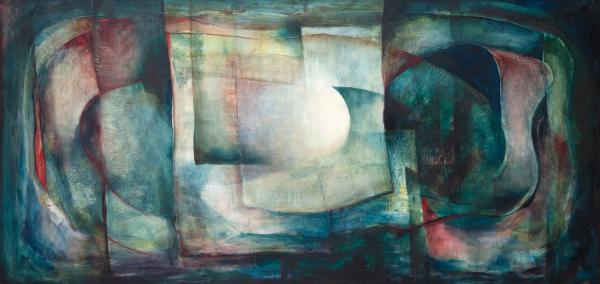
41. ERNEST SIDNEY PHILPOT
(1906-1985)NO ULTIMATE REALITY
Signed lower right
Oil on board
118 x 200cm
Estimate: $9,000/$12,000
Hammer Price - $9,500

Visual guide only. Framed size is used when available; otherwise artwork size is shown.
About this artwork
Ernest Philpot was a trailblazer in the Western Australian art scene, recognized as the first exponent of non-objective abstract painting in the state. While he wasn’t known for being a social butterfly or a fixture at parties, he found deep fulfillment in the solitude of his studio, immersed in his work and often limiting his palette to a restrained selection of colours. Read full essay Show less
Ernest Philpot was a trailblazer in the Western Australian art scene, recognized as the first exponent of non-objective abstract painting in the state. While he wasn’t known for being a social butterfly or a fixture at parties, he found deep fulfillment in the solitude of his studio, immersed in his work and often limiting his palette to a restrained selection of colours.
Born in England in 1906, Philpot emigrated to Western Australia with his family in 1913. At a time when artists in the region found it difficult to sustain a livelihood through art alone, Philpot defied convention, embracing abstraction long before it gained widespread acceptance.
In search of a broader audience and critical recognition, Philpot held a solo retrospective exhibition in London during the winter of 1960–1961. Hosted at The Commonwealth Institute in Kensington, the show presented a body of work spanning three decades—from traditional early pieces to his evolution into abstraction. Though the exhibition was a significant milestone, his efforts to establish a presence in the London art world were hampered by his lack of familiarity with the British art market and its expectations. His aspirations for international acclaim went largely unfulfilled, leaving him disheartened.
Philpot led a rich and varied life beyond the canvas. He studied at the National Gallery School in Victoria, served as a field surveyor with the Australian Army during World War II, and played the euphonium in a Salvation Army brass band. His talents were acknowledged with awards including the Claude Hotchin Painting Prize in 1948 and the Art Gallery of Western Australia Prize for Oil Painting in 1952.
Throughout his career, Philpot remained a committed member of the local art community, regularly exhibiting with the Perth Society of Artists. He also managed a signwriting business he inherited from his uncle in 1937. In 1957, he sold the business and took up a position as an art master at Wesley College, where he taught until his retirement in 1968. During this time, he also served as an art critic for the Perth Sunday Times from 1961 to 1965.
This work,“No Ultimate Reality”, is one of the largest pieces he worked on and exemplifies his commitment to pure abstraction. The painting analyses the fundamental elements of visual language—shape, colour, and texture—in a way that challenged conventional art norms of the time. While such work is now distinguished, it was initially met with uncertainty in conservative 1960s Perth. Still, Philpot remained steadfast in his artistic convictions, undeterred by public opinion.
A key factor that enabled Philpot to remain true to his artistic vision was his financial independence. Free from the pressure to produce commercially viable work, he was able to explore uncharted creative territory on his own terms.
Today, Ernest Sidney Philpot’s contributions to Australian modernism are widely recognized. His works are held in prominent collections including the Art Gallery of Western Australia, the University of Western Australia, the National Gallery of Australia, and numerous regional and private collections across the country. His legacy endures as a testament to artistic courage, innovation, and integrity.