
Autumn 2025 Art Auction
64. CHARLES FRANK NORTON
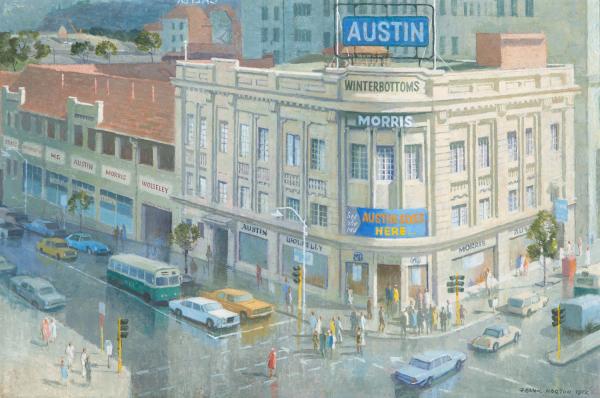
(1916-1983)WINTERBOTTOMS
Signed and dated 1972 lower right
Oil on board
58 x 89cm
Estimate: $5,000/$8,000
Hammer Price - $5,200

Visual guide only. Framed size is used when available; otherwise artwork size is shown.
About this artwork
Frank Norton was not an artist known for pushing boundaries, but rather for his dedication to faithfully capturing the world around him. He was not driven by a desire to break new ground in the art world, but by a commitment to providing an artist's perspective on everyday events. Read full essay Show less
Frank Norton was not an artist known for pushing boundaries, but rather for his dedication to faithfully capturing the world around him. He was not driven by a desire to break new ground in the art world, but by a commitment to providing an artist's perspective on everyday events.
Norton's reputation, achievements, and military service have been well-documented. He was appointed an official war artist during both World War II and the Korean War. Following these wartime assignments, he taught at the East Sydney Technical College. Before being appointed as the Director of the Art Gallery of Western Australia from 1958 to 1976, a position that allowed him to significantly influence that institution's direction.
With the support of his dedicated staff, Norton expanded the gallery's collection of Aboriginal artefacts and Australian Impressionist works. He also designed and oversaw the construction of the current Art Gallery of WA, while managing to navigate challenging press coverage when some of the gallery’s acquisitions were deemed controversial.
Amidst these professional responsibilities, Norton remained focused on his personal artistic practice, and travelled extensively within the state in his professional capacity. He meticulously documented his surroundings, making detailed notes and sketches of the world he encountered. These observations were not merely for personal expression but intended as a record for future generations.
One lesser-known aspect of his wartime service is his close call during the Battle of Tobruk, where he was nearly killed by shellfire. As the explosion threw him in one direction and his easel and paints in another, Norton’s determination to document the realities of war persisted. Unlike many artists of the time, he chose not to focus on the sensational, heroic moments that were widely reported, but on the daily routines and seemingly mundane tasks that, in his view, were essential to the success of the military effort. These uncelebrated moments were, for him, just as significant as the acts of bravery that earned medals.
This 1972 oil painting depicts the Winterbottom Motors building at the corner of St Georges Terrace and Mill Street in Perth on a rainy day. It exemplifies the artist’s keen eye for detail and his ability to capture the ordinary events of daily life. Over time, such scenes have become valuable records of a city that continues to undergo significant change. The artist goes beyond simply recording the vehicles, buildings and fashion of the time; in the background, he also includes dredging activity in the Swan River.
Through his steadfast commitment to observation and documentation, Frank Norton offered a quiet yet powerful alternative to the more dramatic narratives of his time. His work stands as a testament to the enduring value of the ordinary — the streets we walk, the work we do, the moments we often overlook. In capturing these fragments of daily life with precision and care, Norton created not just art, but a visual history that continues to resonate. His legacy lies not in revolutionizing artistic technique, but in elevating the everyday to a place of significance, ensuring that the seemingly mundane is remembered with the dignity it deserves.