
Autumn 2025 Art Auction
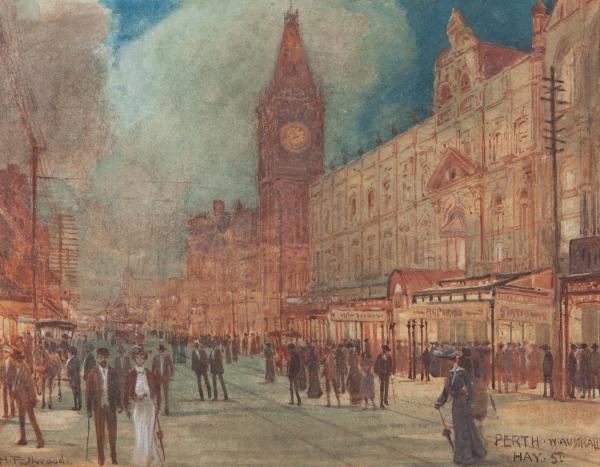
52. ALBERT HENRY FULLWOOD
(1863-1930)HAY STREET PERTH
Signed lower left and titled lower right
Watercolour and gouache
15.5 x 20.5cm
Estimate: $3,000/$5,000
Hammer Price - $5,200

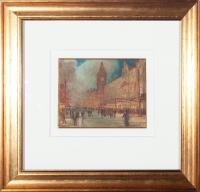
Visual guide only. Framed size is used when available; otherwise artwork size is shown.
About this artwork
This captivating image, often mistakenly dated 1911, was in fact painted in 1899—capturing a defining moment in Perth’s transformation at the turn of the century. Read full essay Show less
This captivating image, often mistakenly dated 1911, was in fact painted in 1899—capturing a defining moment in Perth’s transformation at the turn of the century.
The artist Albert Henry Fullwood, had already earned acclaim as a staff artist for the prestigious Picturesque Atlas of Australasia. For five and a half years, he travelled extensively across Australia, New Zealand, and New Guinea, documenting the landscapes and life of the time with exceptional precision and clarity.
In 1898, Fullwood arrived in Western Australia, journeying from Albany to Geraldton to create illustrations for the Atlas. It was during this period that he painted “Hay Street, Perth”, immortalizing the city on the cusp of a new era. Trams had just arrived—brought in by the Perth Electric Tramways, a private company that would later be absorbed by the state government in 1913.
Fullwood’s attention to detail allows us to step back into that very evening. Federation was still two years away, but the buzz of prosperity, ignited by the 1893 gold discovery in Kalgoorlie, was already in the air. The streets of Perth bustle with life—ladies in long dresses and parasols, gentlemen in tailored suits, and the city’s elite out in full formality, as a visit to the capital called for nothing less. A horse-drawn cab waits for passengers while electric trams are seen in the background. The first motorcars wouldn’t appear on Perth streets for another seven years.
Though this particular piece never made it into the Picturesque Atlas , it found a second life in 1911 when postcard publishers Raphael Tuck and Sons selected it for a series celebrating Australia. And so, despite the mislabelling, this artwork remains a stunning visual time capsule to a moment of change, growth, and elegance in early Western Australia.