
Autumn 2025 Art Auction
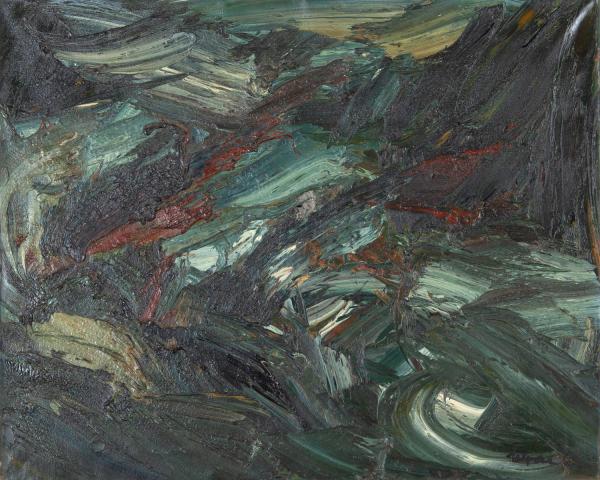
32. STANISLAW (STACHA) HALPERN
(1919-1969)STORM ON THE MOUNTAIN
Signed and dated 62 lower right
Oil on canvas
80 x 100cm
Estimate: $8,000/$12,000
Hammer Price - $6,000

Visual guide only. Framed size is used when available; otherwise artwork size is shown.
About this artwork
Stacha Halpern - painter, potter, printmaker and sculptor - was born in Zolochev, Poland (now Ukraine) in 1919. In 1938, he enrolled at the School of Commercial and Fine Art in L'vov (Poland), but his studies were cut short by the German invasion of Poland. He emigrated to Perth via England, and in 1939 moved to Melbourne, where he worked as a fitter and turner. Read full essay Show less
Stacha Halpern - painter, potter, printmaker and sculptor - was born in Zolochev, Poland (now Ukraine) in 1919. In 1938, he enrolled at the School of Commercial and Fine Art in L'vov (Poland), but his studies were cut short by the German invasion of Poland. He emigrated to Perth via England, and in 1939 moved to Melbourne, where he worked as a fitter and turner.
While employed at a Melbourne commercial pottery, Halpern befriended Arthur Boyd, who, along with John Perceval, had established the Arthur Merric Boyd Pottery at Murrumbeena. In 1946– - 47, Halpern set up a home studio with the goal of becoming a full-time potter. Despite financial difficulties, he found reasonable success selling his work through the Primrose Pottery Shop in Melbourne. He studied part-time at the George Bell School in 1948 - 49 and attended Melbourne Technical College for one term.
Halpern became a naturalised Australian in 1947. In 1951, he returned to England and Europe, where he spent the next fifteen years leading a semi-nomadic life and focusing primarily on painting. He made a notable impact on the European art scene, exhibiting frequently in solo and group exhibitions across Paris, Amsterdam, Rome, Basel, and Milan. His paintings from the mid- to late 1950s were bold, expressionistic landscapes and streetscapes - vigorously executed with thick paint and gestural, calligraphic lines.
In 1966, Halpern returned to Melbourne. His focus increasingly turned to the human figure, rendered in dark, brooding, often fragmented forms. At a time when the Australian art world was increasingly captivated by American ‘colour field’ abstraction, Halpern’s intense European expressionism set him apart. Undeterred, he remained prolific until his sudden death from heart disease in early 1969, just shy of 50 years old.
He was one of the few Australian painters to gain significant recognition overseas, with a strong exhibition presence throughout Europe. Yet, for reasons not entirely clear, he has never been fully appreciated in his adopted homeland. Perhaps his paintings were not vibrant enough to capture the wider public imagination or he was affected by the conflict between the Antipodeans and Abstractionists. His work has long been understood and valued by institutional curators and is included in the collection of most Australian Galleries and the National Collection in Canberra.